This guide covers the practical basics: where to source, what types are available, how to evaluate quality, and why crystals remain a fast-moving product category for many wholesale and retail buyers.
Quick Navigation
1. Where Are China’s Crystal Hubs?
Donghai County, Lianyungang, Jiangsu Province — The Crystal Capital
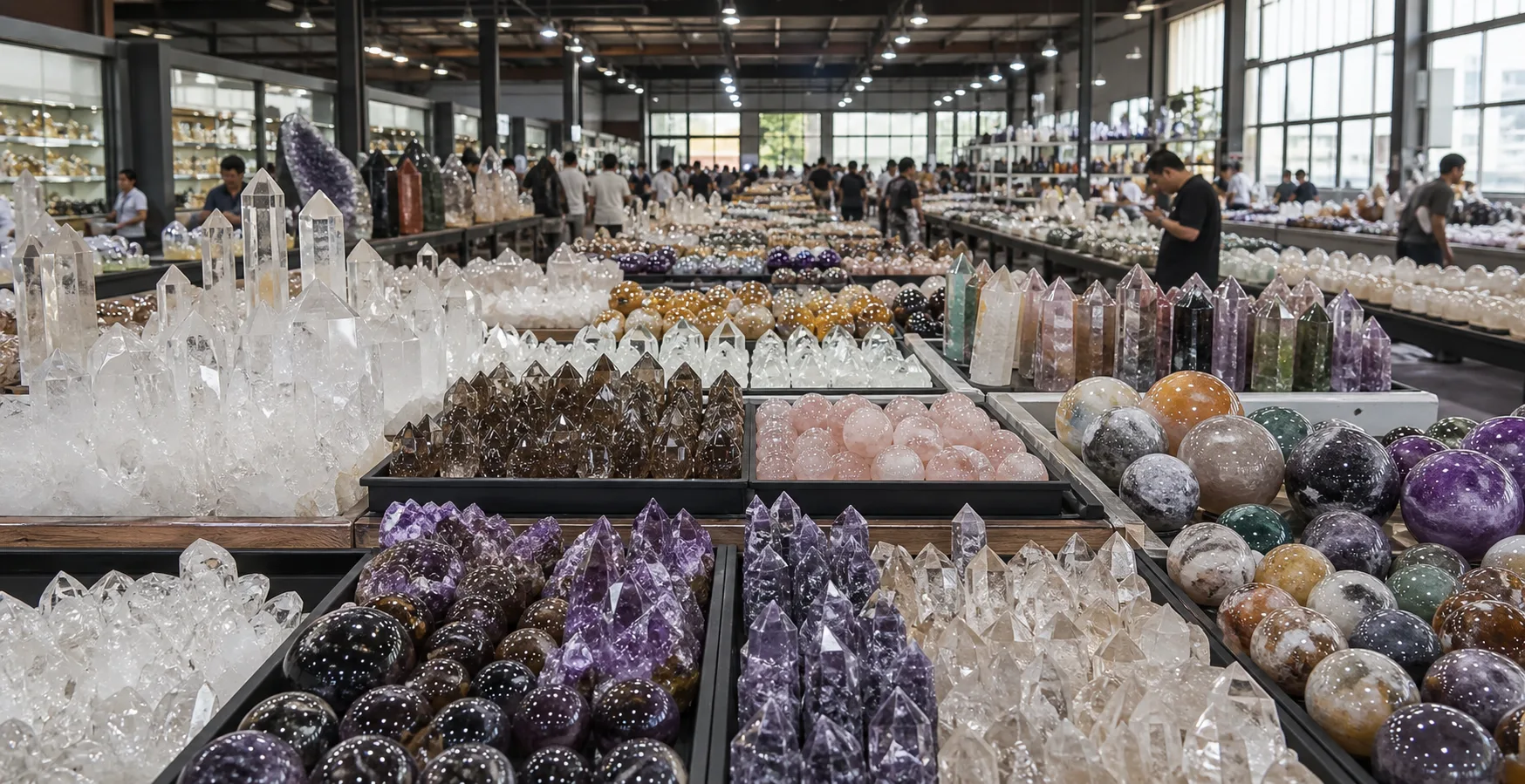
One place many crystal buyers study first is Donghai County. Known as the “Crystal Capital of China,” Donghai is one of the world’s largest and most comprehensive crystal trading markets.
The local industry covers the entire supply chain — from raw ore mining and cutting to polishing, carving, and wholesale distribution. The famous Donghai Crystal City houses hundreds of vendors across multiple halls (Hall 1, Hall 2, and beyond), with fierce competition keeping prices extremely competitive.
Outside the market buildings, daily street vendors trade raw stones and finished goods at very competitive prices. The volume and variety available in Donghai are hard to match.
For B2B buyers, Donghai is one of the most important destinations in China for crystals, gemstones, and related products.
Other Notable Sourcing Regions
| Region | Specialty | Best For |
|---|---|---|
| Guangdong Jieyang | Jade and colored gemstone processing | High-end jade, colored stones |
| Yunnan Tengchong | Raw jade and gemstone trading | Burmese jade, raw materials |
| Zhejiang Yiwu | Crystal gifts, jewelry, decorative items | Finished consumer products, small gifts |
2. What Types of Crystals Are Available?
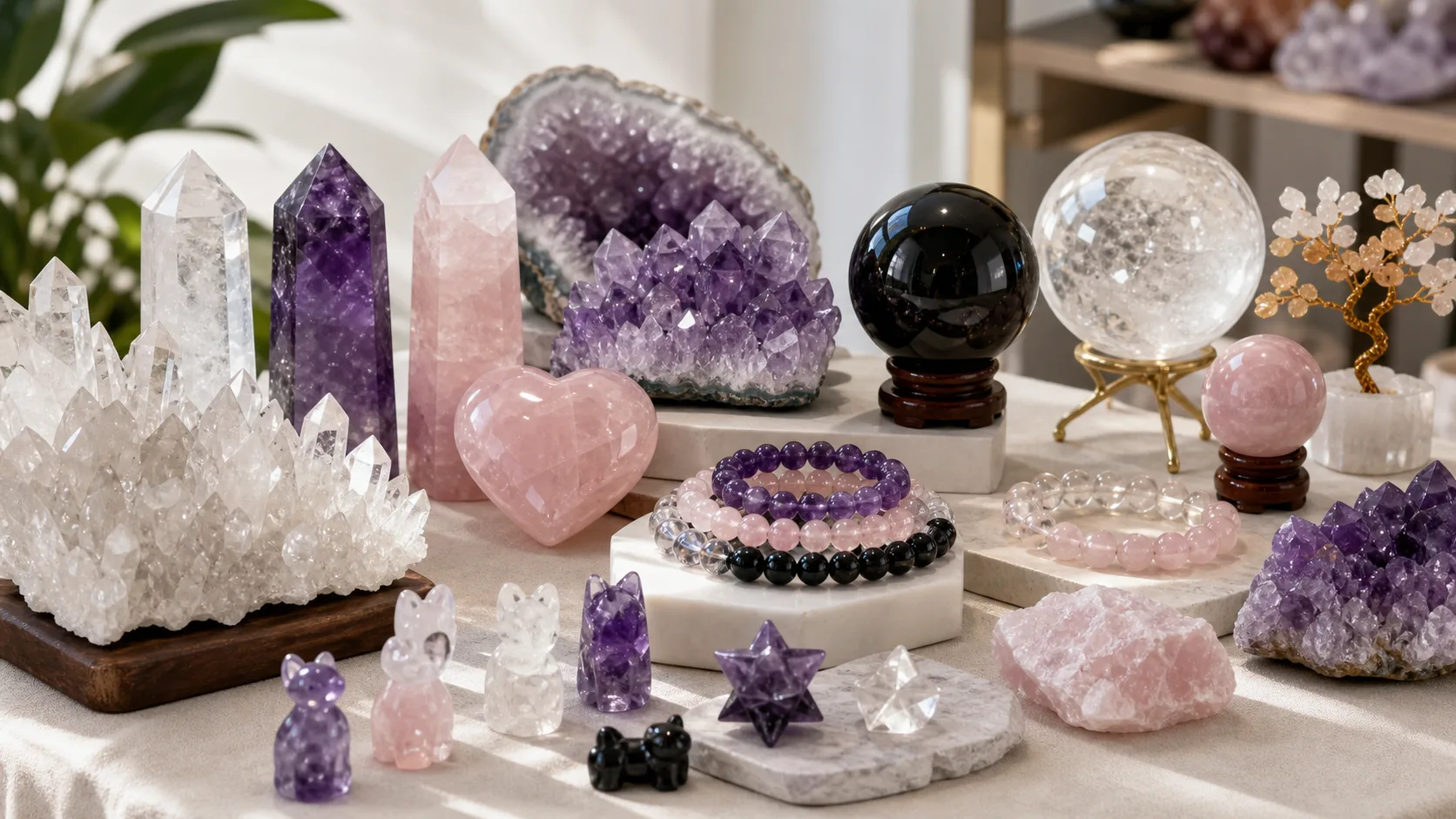
China’s crystal markets offer an extraordinary range of product types. Here is a breakdown of the main categories:
Raw & Specimen
- Raw Stones: Unprocessed natural crystals in their original form. Highly popular in the Western spiritual and collector market.
- Mineral Specimens: Display-grade crystal formations with strong collector and decorative appeal.
Shaped & Polished Forms
- Freeform (随形): Natural-shaped pieces with light polishing. Retains the organic feel of raw stone while being more refined.
- Points / Towers (单尖): The classic crystal shape. Single-terminated towers are among the best-selling items globally.
- Spheres (球): Perfectly round, symbolizing wholeness and harmony. Popular for meditation, home decor, and high-end gifting.
- Hearts (爱心): A universally recognizable shape. Strong seller for Valentine’s Day, anniversaries, and self-love themes.
- Palmstones (把玩石): Smooth, oval-shaped stones designed to fit in the palm. Perfect for meditation and stress relief.
- Crystal Bowls (水晶碗): Large decorative pieces. Premium gift market.
Jewelry & Semi-Finished
- Beaded Bracelets (手串): One of the highest-volume retail products. Consistent global demand across all markets.
- Semi-finished Beads (半成品): Loose beads for downstream brands and designers to string themselves.
Carvings & Sculptures
- Traditional Carvings: Pi Xiu (wealth charm), dragons, Guanyin, gourds — classic Feng Shui and gifting categories.
- Licensed & Custom Character-Style Carvings: Some workshops produce character-style crystal sculptures or custom branded pieces. For export buyers, licensing and intellectual property checks are essential before importing.
- Custom Carvings: Many Donghai workshops accept custom orders for branded or personalized crystal sculptures.
3. How to Evaluate Crystal Quality
Knowing how to assess quality is essential for any buyer. Here are the key criteria used by experienced crystal traders:
1. Clarity — The Most Important Factor
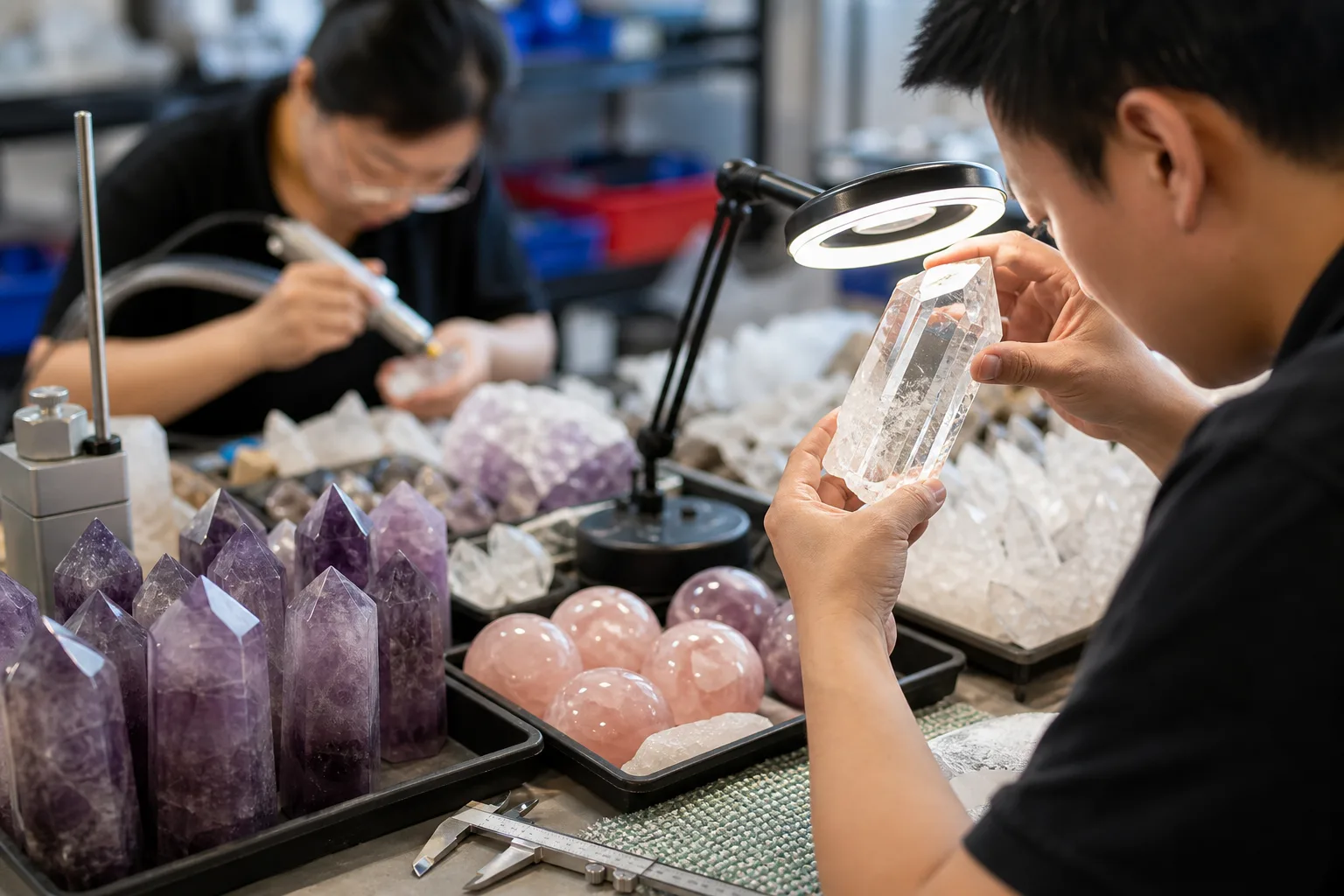
The single most important quality indicator is transparency. The clearer and more transparent the crystal, the higher its value. Hold the piece up to a strong light source and look through it. High-quality crystals will appear clean and luminous.
2. Inclusions & Veiling (棉絮)
White, cloud-like formations inside a crystal are called inclusions or “veils.” A small amount is natural and acceptable — even desirable in some spiritual traditions. However, heavy inclusions significantly reduce clarity and market value. Always check the ratio before buying in bulk.
3. Cracks & Fractures
Internal fractures weaken the stone and affect its visual quality. Use a flashlight to inspect for cracks, especially near the surface. Surface cracks are more problematic than deep internal ones. Avoid pieces with structural cracks that could cause breakage.
4. Color Consistency (for Colored Crystals)
For amethyst, rose quartz, citrine, and other colored varieties, evaluate whether the color is evenly distributed and sufficiently saturated. Patchy or faded color reduces retail appeal significantly.
5. Craftsmanship & Polish
For polished and carved pieces, examine the surface finish closely. Is it smooth and even? Are edges clean? Is the shape symmetrical? Poor finishing will be immediately noticed by end consumers.
6. Weight & Density
All else being equal, a heavier crystal of the same size indicates higher density and typically better quality. Always handle pieces in person when possible, or request weight specifications from suppliers.
4. Why Crystals Sell — Market Appeal & Consumer Benefits
Understanding why consumers buy crystals is essential for positioning your products effectively across different markets.
Spiritual & Metaphysical Properties — The Western Market Driver
In North America, Europe, and Australia, the spiritual dimension of crystals is the primary purchase driver. Consumers believe that different crystals carry distinct energetic properties:
| Crystal | Believed Property | Best-Selling Form |
|---|---|---|
| Clear Quartz | Amplifies energy and intention — “Master Healer” | Points, spheres |
| Amethyst | Enhances intuition, supports meditation | Clusters, jewelry |
| Rose Quartz | Unconditional love, self-love | Hearts, palmstones |
| Black Obsidian | Protection, absorbs negative energy | Spheres, carvings |
| Citrine | Abundance, prosperity, positive energy | Points, tumbled stones |
| Moonstone | Feminine energy, new beginnings | Jewelry, palmstones |
This market overlaps heavily with the wellness, meditation, manifestation, and witchcraft aesthetics communities — all of which are experiencing significant growth on social media platforms globally.
Consumers in this segment are willing to pay a substantial premium for crystals that have been “charged,” “cleansed,” or come with spiritual intention setting. This opens strong opportunities for value-added services.
Feng Shui & Wealth Attraction — The Chinese & Asian Market
In Chinese and broader Asian consumer culture, crystals are deeply connected to Feng Shui practice:
- Large crystal geodes placed in the home are believed to attract wealth and positive energy (招财进宝)
- Pi Xiu carvings in crystal are among the most popular wealth symbols
- Crystal spheres on a desk symbolize career success and smooth fortune
- Green Phantom Quartz (绿幽灵) is often marketed as a premium wealth-attracting crystal and can command higher prices
Gift Market — Premium Gifting at Accessible Price Points
Every crystal is unique — no two pieces are identical. This natural exclusivity makes crystals an inherently premium gifting product:
- Corporate Gifts: Large crystal sculptures and geodes project sophistication and thoughtfulness
- Personal Gifts: Heart-shaped crystals, bracelets, and palmstones work for birthdays, anniversaries, Valentine’s Day, and housewarmings
- Souvenirs & Travel Retail: Small polished pieces are ideal impulse purchases with strong margins
The “natural and unique” narrative resonates strongly with consumers who are moving away from mass-produced gifts.
Collectibles & Home Decor
- Mineral specimen collecting has active online communities and strong social media visibility
- Crystals integrate seamlessly with popular interior design aesthetics including Japandi, Boho, and Cottagecore styles
- Licensed character-style crystal carvings can generate social media engagement when IP permissions and market rules are handled correctly
5. B2B Sourcing Tips
- Visit Donghai in person for your first sourcing trip if possible. Building face-to-face relationships with suppliers is the most effective way to secure reliable long-term supply.
- Start with small test orders before committing to large volumes. Test different product categories to identify what sells best in your specific market.
- Learn to distinguish natural crystals from glass imitations. Natural crystals feel cooler to the touch, have natural inclusions, and show slight imperfections. Perfect clarity at very low prices is a red flag.
- Establish relationships with 2–3 suppliers rather than just one. This protects your supply chain and gives you pricing leverage.
- For carved character or IP-related products, verify intellectual property regulations in your target market before importing.
- Consider value-added services such as energy charging, crystal pairing recommendations, or custom packaging to differentiate your offering and justify higher retail pricing.
Conclusion
Sourcing crystals from China offers B2B buyers a strong combination of cost advantage, product variety, and supply chain depth. The key to success lies in understanding the sourcing hubs, knowing how to evaluate quality, and positioning your products for the right market segment — whether that’s spiritual consumers in the West, Feng Shui buyers in Asia, gift buyers, or collectors.
Start with a focused product range, build reliable supplier relationships, and scale based on what your specific customer base responds to. The crystal market is growing fast, and buyers who establish their supply chains now will be well-positioned for the years ahead.
Ready to start sourcing crystals from China? Contact us for supplier introductions, market guidance, or to discuss your specific sourcing needs. We help B2B buyers navigate the Chinese crystal market with confidence.
Frequently Asked Questions (FAQ)
What is the minimum order quantity (MOQ) for crystals from China?
MOQ varies by supplier and product type. For raw stones and tumbled items, MOQs can be as low as 50–100 pieces. For custom-carved items or jewelry, MOQs typically start at 200–500 pieces. Always negotiate — many Donghai suppliers are flexible, especially for first-time buyers placing test orders.
How do I verify if a crystal is natural or synthetic?
Natural crystals typically have minor inclusions, slight color variations, and feel cool to the touch. Glass imitations warm up quickly when held, often have tiny air bubbles, and appear unnaturally perfect. For high-value purchases, request a certificate from a recognized gemological laboratory.
What is the typical lead time for crystal orders from China?
Stock items (raw stones, standard polished shapes) usually ship within 3–7 days. Custom-carved or custom-cut pieces typically require 15–30 days depending on complexity and order volume. Factor in additional time for sea freight (15–30 days to most destinations).
Can I visit Donghai Crystal City as a foreign buyer?
Yes. Donghai Crystal City welcomes international buyers. Many vendors speak basic English, and hiring a local interpreter or sourcing agent is recommended for your first visit. The market operates year-round, but visiting during the major trade fairs (especially the annual Donghai Crystal Festival) offers additional networking opportunities.
What are the most profitable crystal products to sell?
Based on current market trends, higher-margin categories often include: (1) crystal jewelry — especially beaded bracelets with strong markup potential, (2) licensed or original custom carvings, (3) spiritual sets — curated crystal kits for meditation or intention-setting markets, and (4) large statement pieces — geodes and sculptural carvings for home decor.
How do crystals get shipped internationally from China?
Most B2B crystal shipments go by sea freight (FCL or LCL) for cost efficiency. For smaller or urgent orders, air freight or express courier (DHL, FedEx) is available at higher cost. Ensure your supplier uses proper packaging — foam-lined crates for fragile items — and confirm customs documentation requirements for your country before shipping.