Choosing the right surface treatment for your hardware tools is one of the most consequential decisions you will make as a B2B buyer. Get it right, and your tools sell themselves — consistent finish, reliable performance, satisfied end customers. Get it wrong, and you face returns, complaints about rust, or a product that looks cheap on the shelf.
This guide covers everything you need to know: which treatment fits which tool type, how to evaluate quality, what to ask your factory, and how to balance cost with performance.
Quick Navigation
- 1. How to Match Surface Treatments to Tool Types
- 2. Electroplating — Zinc, Nickel, and Chrome
- 3. Powder Coating — Durable and Decorative
- 4. Anodizing — For Aluminum Tool Parts
- 5. Blackening and Phosphating — Low-Cost Rust Protection
- 6. PVD and DLC Coating — Premium Hard Surfacing
- 7. Hot-Dip Galvanizing — Heavy-Duty Outdoor Protection
- 8. Nitriding — Surface Hardening for Wear-Prone Tools
- 9. Polishing and Mechanical Finishing
- 10. B2B Quality Checklist — What to Verify Before You Ship
- Frequently Asked Questions (FAQ)
- References and Further Reading
1. How to Match Surface Treatments to Tool Types
Before diving into each process, here is the most practical question to answer first: what should go on what tool?
The decision comes down to four factors:
- Tool material — Steel? Aluminum? Stainless steel? Each limits your options.
- Usage environment — Indoor tool storage? Outdoor construction site? Humid coastal warehouse?
- Budget tier — Dollar-store pricing or premium retail?
- Aesthetic target — Mirror chrome? Matte black? Colorful ergonomic handles?
Quick Decision Matrix
| Tool Type | Best Surface Treatment Options | Typical Budget |
|---|---|---|
| Budget wrenches, pliers (indoor use) | Blackening + oil, or thin zinc plating | Very Low |
| Mid-range hand tool sets | Zinc plating (yellow/blue passivation) | Low |
| Aluminum tool bodies (levels, clamps) | Type II or Type III anodizing | Low–Medium |
| Cutting tools (drill bits, blades) | PVD coating (TiN, TiAlN) or nitriding | Medium–High |
| Heavy outdoor tools (pipe wrenches) | Hot-dip galvanizing or Dacromet | Medium |
| Premium automotive tool sets | Hard chrome plating or nickel + chrome | Medium |
| High-end precision tools | DLC coating or mirror polishing | High |
| Consumer garden tools | Powder coating (colorful, impact-resistant) | Low–Medium |
| Handles and grips (pliers, hammers) | Powder coating or dip coating | Low–Medium |
Now let us look at each treatment in detail.
2. Electroplating — Zinc, Nickel, and Chrome
What It Is
Electroplating deposits a thin metal layer onto the tool surface through an electrochemical reaction. Three common types:
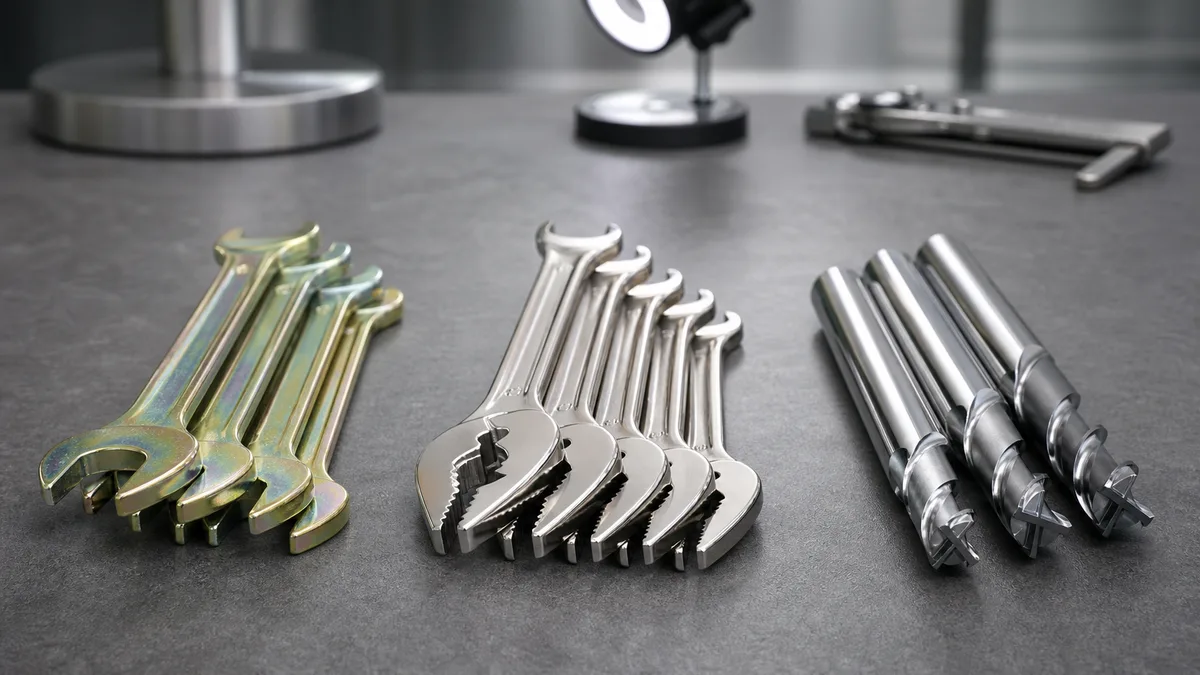
- Zinc plating — The workhorse of tool corrosion protection. Available with blue, white, or yellow passivation (the passivation color affects corrosion resistance slightly — yellow is generally the most protective).
- Nickel plating — Bright, corrosion-resistant surface. Often used as an underlayer for chrome.
- Hard chrome plating — Hard, low-friction surface. Used on cutting and forming tools where wear resistance matters as much as corrosion protection.
Best Applications
| Process | Best For | Not Suitable For |
|---|---|---|
| Zinc plating | Indoor hand tools, fasteners, general hardware | Outdoor exposure, food contact |
| Nickel plating | Decorative tool finishes, undercoat for chrome | High-wear surfaces (too soft alone) |
| Hard chrome | Cutting tools, punches, dies, hydraulic rods | Thin-walled parts (embrittlement risk) |
What to Look for in Quality
- Salt spray test: Request hours-to-red-rust data. 48+ hours for zinc (indoor), 200+ hours for hard chrome. ISO 9227 is the international standard for neutral salt spray testing.
- Hydrogen embrittlement relief bake: Absolutely mandatory for high-strength steel tools (HRC ≥ 40). If your factory does not do this step, walk away — tools can crack in the field.
- Thickness check: 5–15 μm for zinc, 10–30 μm for hard chrome. Use a magnetic thickness gauge on multiple points per ISO 2178.
- Passivation type: Trivalent chromium (Cr³⁺) is now the standard. Hexavalent chromium (Cr⁶⁺) is being phased out globally for environmental and worker safety reasons.
Common Pitfall
Zinc plating that looks perfect out of the box but fails after three months of storage. The root cause is usually insufficient passivation or no post-seal rinse. Ask the factory for their full process sequence — a good line includes: clean → acid dip → zinc plate → passivate → seal → dry → bake (if needed).
Cost level: Low (zinc) to Medium (chrome/nickel)
3. Powder Coating — Durable and Decorative
What It Is
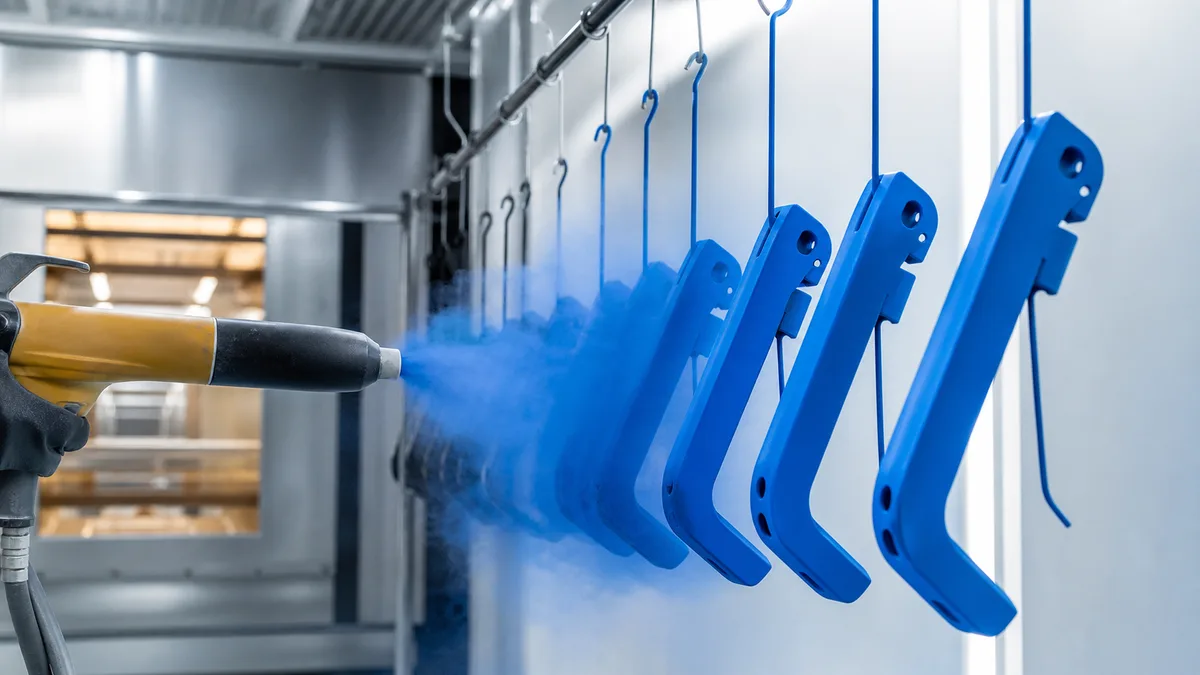
Electrostatic spraying of dry powder onto the tool surface, followed by oven curing at around 180–200°C. The result is a thick, durable, uniformly colored coating that outperforms wet paint in almost every way. Unlike liquid paint, powder coating produces zero VOC emissions and overspray can be recycled.
Best Applications
- Pliers handles, hammer heads, screwdriver shafts (full coverage)
- Garden tools — spades, pruners, trowels
- Tool chests, storage cabinets, workshop stands
- Pipe wrenches and heavy-duty hand tools
Why Choose It Over Paint
- Thicker: 50–200 μm versus 15–35 μm for liquid paint
- Tougher: Excellent impact and chemical resistance
- Cleaner: No VOCs, less waste, faster cure times
- More choices: Matte, gloss, textured, metallic, hammer-finish
What to Watch Out For
- Edge coverage: Sharp edges get less powder due to electrostatic repulsion. Ask the factory to pre-heat the part or use a tribo gun for better edge coverage.
- Curing consistency: Large temperature variations in the oven cause uneven gloss. Check that the oven has zone temperature control.
- Adhesion: Cross-hatch tape test per ISO 2409. Acceptable rating: Class 1 or 0 (≤5% removal).
When It Is the Wrong Choice
- Parts with pre-assembled components that cannot take 200°C heat (plastic inserts, rubber grips)
- Precision-machined surfaces where coating thickness would affect tolerances
- Tools that will be used for food preparation
Cost level: Low (solid colors) to Medium (textured or multi-coat)
4. Anodizing — For Aluminum Tool Parts
What It Is
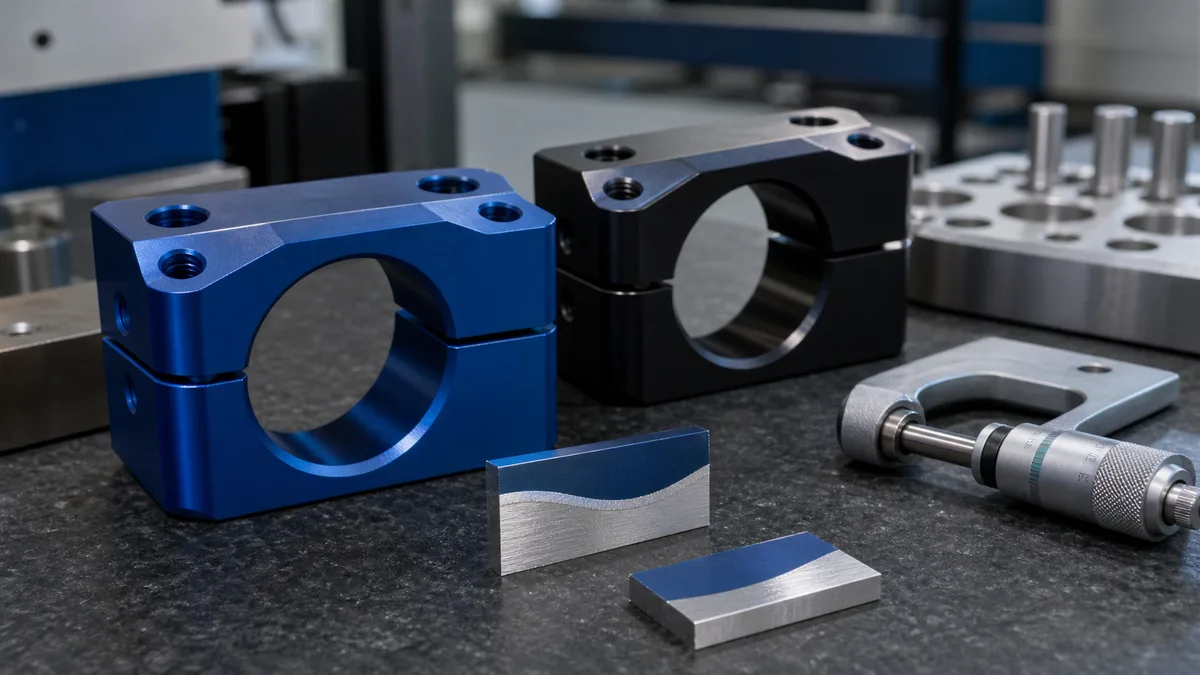
An electrochemical process that thickens the natural oxide layer on aluminum. Unlike plating, anodizing does not deposit a coating — it converts the existing aluminum surface into a hard, porous oxide that can then be sealed or dyed.
Two main types:
- Type II (sulfuric anodizing): 5–25 μm, decorative, dyeable in any color
- Type III (hard anodizing): 25–100 μm, very hard (300+ HV), good wear resistance
Best Applications
- Aluminum ratchet handles, flashlight bodies, clamps
- Levels, squares, measuring tools
- Ladder components
- High-end consumer tool housings
Critical Quality Check: Seal Quality
Anodized aluminum is porous after the bath. If the pores are not properly sealed, the surface will stain, absorb dirt, and lose corrosion resistance. The industry test is a dye spot test (ASTM B136): put a drop of dye on the surface, wait, rinse. If the dye soaks in, the seal failed.
When Not to Use Anodizing
- Steel tools — Anodizing only works on aluminum (and a few other non-ferrous alloys)
- Parts requiring maximum fatigue strength — anodizing slightly reduces it
- Applications where UV stability matters — dyed colors can fade in direct sunlight over years
Cost level: Low (Type II) to Medium (Type III hard anodizing)
5. Blackening and Phosphating — Low-Cost Rust Protection
What It Is
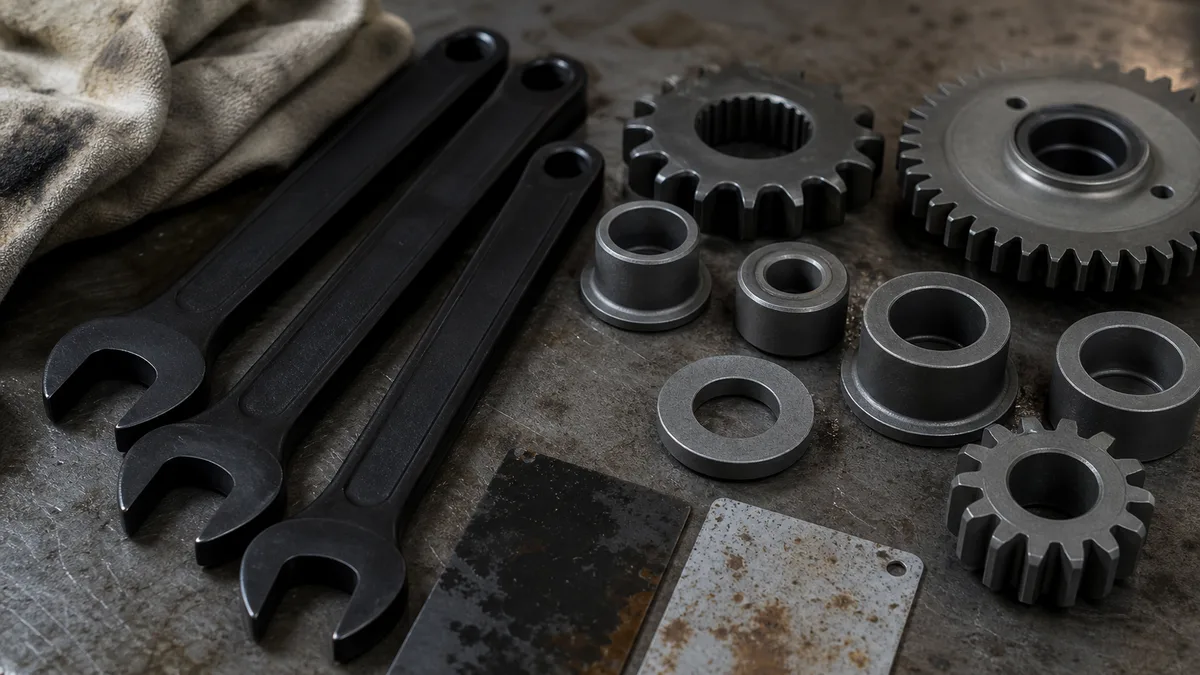
- Blackening: A chemical conversion process that creates a black iron oxide (Fe₃O₄) layer on steel. Common in hot blackening (140°C) and cold blackening (room temperature) variants.
- Phosphating: Forms a crystalline phosphate layer on steel. Available in manganese phosphate, zinc phosphate, and iron phosphate varieties.
Best Applications
| Treatment | Common Tools | Why |
|---|---|---|
| Blackening + oil | Economy wrenches, pliers, screwdrivers | Lowest cost, matte black finish |
| Manganese phosphate | Gears, bushings, sliding parts | Retains lubricant in micropores |
| Zinc phosphate | Fasteners, springs | Good paint base, moderate corrosion |
The One Thing Every Buyer Must Understand
Blackening and phosphating provide almost no corrosion protection on their own. The protection comes entirely from the post-treatment seal — oil, wax, or lacquer applied after the conversion coating.
If your factory skips the oil seal step (or uses low-quality oil that dries out), tools will rust within days in humid conditions. This is by far the most common quality complaint with blackened tools.
Salt Spray Expectations
Be realistic: blackened tools typically pass 4–24 hours of neutral salt spray per ISO 9227. If your buyer requires 72+ hours, do not choose blackening.
Cost level: Very Low
6. PVD and DLC Coating — Premium Hard Surfacing
What It Is
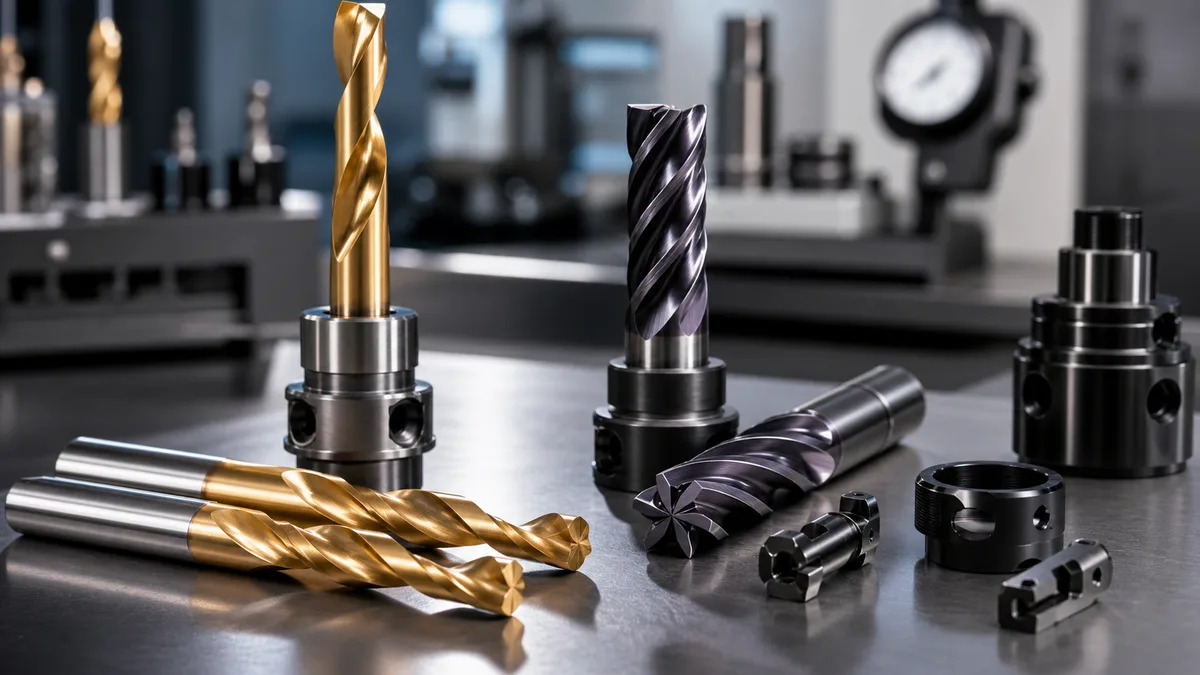
Physical Vapor Deposition (PVD) applies a thin (1–5 μm), ultra-hard ceramic or metallic coating in a vacuum chamber. Diamond-Like Carbon (DLC) is a carbon-based PVD coating that adds extremely low friction.
Common types:
- TiN (titanium nitride) — Gold color, most common, ~2300 HV
- TiAlN (titanium aluminum nitride) — Violet-grey, stable at high temperatures (800°C+)
- CrN (chromium nitride) — Silver, good corrosion resistance
- DLC (diamond-like carbon) — Black, μ=0.1–0.2 friction coefficient
Best Applications
- Cutting tools — HSS and carbide drills, end mills, taps, inserts
- Precision screwdriver bits and nut drivers
- Surgical and dental instruments
- Automotive engine components
The Cost vs. Benefit Decision
PVD adds 3–10× the per-part cost of conventional plating. It is worth it when:
- The tool cuts, drills, or machines other materials (the coating extends tool life 3–5×)
- Low friction is critical for the application
- The tool is sold at a premium price point where the coating is a visible selling point
It is not worth it when:
- The tool is a simple hand tool with no cutting function
- The surface is hidden or non-functional (underneath a handle)
- The buyer is price-sensitive
Quality Verification
PVD quality is invisible to the naked eye. You need:
- Coating thickness report (calotest ball crater method or XRF)
- Adhesion test (Rockwell HRC indentation per ISO 26443 — look for no delamination around the indent)
- Hardness data (nano-indentation)
- Color sample card — TiN gold should be consistent across the entire batch
Cost level: High
7. Hot-Dip Galvanizing — Heavy-Duty Outdoor Protection
What It Is
Steel parts are fully immersed in molten zinc at ~450°C. The zinc reacts with the steel to form a series of zinc-iron intermetallic layers, topped with a pure zinc outer layer. The result is a thick (50–150 μm), metallurgically bonded coating.
Best Applications
- Large wrenches, pipe wrenches, heavy pliers
- Scaffolding components, chain blocks
- Outdoor hardware — bolts, nuts, brackets, hinges
- Agricultural tools and structural hardware
The Practical Trade-Offs
What you gain:
- Sacrificial corrosion protection — even if scratched, the surrounding zinc still protects the exposed steel
- Very long service life — decades in outdoor environments
- Self-healing behavior at scratches
What you give up:
- Thick coating can jam threaded parts (order over-tapped threads)
- High temperature can distort thin-walled parts
- Matte grey finish — not retail-shelf pretty
- Not suitable for precise tolerance applications
What to Check
- Coating thickness per ASTM A123 / GB/T 13912: ≥70 μm for hand tools
- Adhesion: Strike test with a hammer — coating should not flake off
- Appearance: No bare spots, no heavy drips or zinc icicles
- Thread fit: Confirm that nuts and bolts have been over-tapped to compensate for coating thickness
Cost level: Medium
8. Nitriding — Surface Hardening for Wear-Prone Tools
What It Is
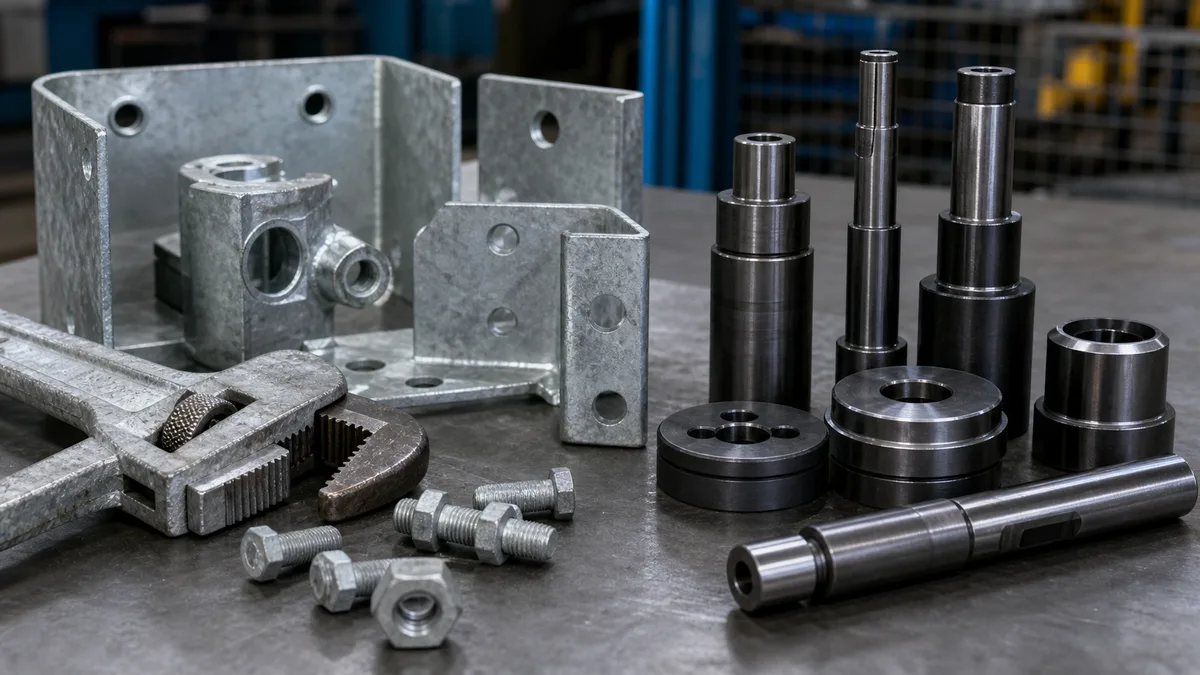
A thermochemical process that diffuses nitrogen into the steel surface at 500–580°C, forming hard nitride compounds. Unlike coatings, nitriding becomes part of the surface — there is no distinct coating layer that can peel off.
Three common methods:
- Gas nitriding: Most common, good for batch processing
- Salt bath nitriding (Tufftride): Faster, adds some corrosion resistance via oxide layer
- Plasma (ion) nitriding: Best dimensional control, for precision tools
Best Applications
- Cutting tools — drills, taps, reamers, blades
- Punches, chisels, impact sockets
- Mold tools, extrusion dies
- High-wear tool surfaces (contact surfaces on pliers, wrench jaws)
What Distinguishes Nitriding from Coating
| Nitriding | Coating (PVD/Plating) |
|---|---|
| No dimensional change (diffusion) | Adds thickness (0.5–150 μm) |
| Cannot peel or flake off | Can delaminate if adhesion fails |
| Hardness 800–1200 HV | Hardness 800–4000 HV (PVD) |
| Requires ferrous alloy | Works on many substrates |
The Key Number: Case Depth
Ask the factory for the case depth — the total depth of the nitrided layer below the surface. For hand tools, 0.3–0.6 mm is typical. Thinner means insufficient wear life; thicker can cause brittleness.
Cost level: Medium to High
9. Polishing and Mechanical Finishing
What It Is
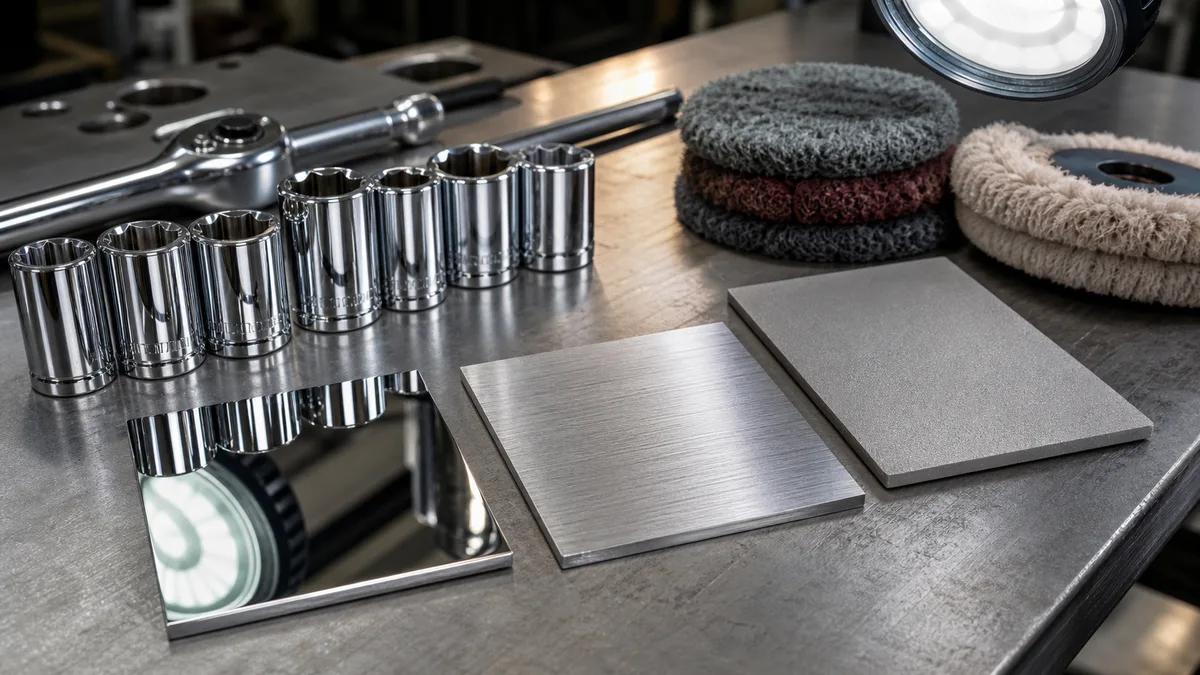
Mechanical finishing prepares or textures the tool surface using abrasives, brushes, or blasting media. Unlike the chemical processes above, it does not add or convert material — it removes or rearranges it.
Three common types:
- Polishing: Successively finer abrasives to achieve a bright, reflective surface
- Sandblasting: High-pressure abrasive stream for matte texture or cleaning
- Shot blasting: Metallic shot impacts for cleaning, descaling, or peening
Best Applications
| Process | Tool Examples | Purpose |
|---|---|---|
| Mirror polishing | Premium socket sets, stainless tools | Aesthetics, corrosion resistance |
| Satin finishing | Kitchen tools, scissors | Uniform matte appearance |
| Sandblasting | Pre-treatment before any coating | Surface cleaning, adhesion improvement |
| Shot peening | Springs, gear surfaces | Fatigue life improvement per SAE J443 |
Assessing Polishing Quality
Polish quality is visible — but there is a quantitative measure. A good mirror finish should have Ra ≤ 0.05 μm (surface roughness per ISO 4287). For satin finishes, Ra 0.4–1.6 μm is typical.
The challenge with polishing is consistency across a batch. Hand-polishing varies by operator skill; robot polishing is more consistent but requires longer setup. Ask to see a batch-level quality report, not a single sample.
Cost level: Medium (robot/semi-auto) to High (hand-polished)
10. B2B Quality Checklist — What to Verify Before You Ship
The 5-Point Quality Verification
1. Salt spray test report — ISO 9227 or GB/T 10125
- Compare actual hours to your specification
- Look for red rust area ≤5% at the target time
2. Coating thickness verification
- ISO 2178 (magnetic) or ISO 2360 (eddy-current)
- Take 5 readings per part on different locations (edge, center, recess)
- Average thickness should match the agreed spec ± tolerance
3. Adhesion test — ISO 2409 or ASTM D3359
- Acceptable: Class 1 or 0 (no peeling)
- Request a video of the test if you cannot visit in person
4. Visual inspection
- Consistent color and gloss across the batch
- No visible drips, runs, bare spots, or contamination
- No rust spots, pitting, or blistering
5. Dimensional check (where applicable)
- Threaded parts after hot-dip galvanizing
- Precision-machined surfaces after coating
- Slot/tolerance-critical features (screwdriver bits, socket drive ends)
Red Flags
- Factory says “we follow the standard” but cannot name a specific standard number
- Claims very high salt spray hours with no supporting documentation
- Does not test every batch — “the process is stable”
- Refuses to let you keep samples for third-party testing
- Cannot explain their hydrogen embrittlement relief protocol for high-strength tools
Frequently Asked Questions (FAQ)
Q: My tools will sit in a warehouse for 6 months before reaching the end customer. What treatment do I need?
If the warehouse is climate-controlled, zinc plating (48+ hours salt spray) or blackening + oil is sufficient. If the warehouse is humid or coastal (e.g., Southeast Asia, Gulf ports), upgrade to at least 8–12 μm zinc with yellow passivation — and request desiccant packs in the master cartons.
Q: Can I combine two surface treatments on the same tool?
Yes, it is very common. Examples:
- Pliers: Blackened steel head + powder-coated handles
- Scissors: Mirror-polished blades + anodized aluminum handles
- Wrenches: Chrome-plated body with dipped PVC grip
The key is process order — surface treatments that require heat (powder coating, nitriding) are typically done before treatments that require precision finish (plating, polishing).
Q: How important is a third-party inspection for surface treatment quality?
Very important — especially for your first order. Factory self-reports tend to be optimistic. A third-party inspection (SGS, Intertek, TÜV) at the production site catches 90% of surface treatment defects before shipment. The cost is usually worth it, especially for salt spray and adhesion testing.
Q: Which surface treatment gives me the best “unboxing experience” for retail?
For premium retail, mirror polishing + clear lacquer (stainless tools) or bright chrome plating (carbon steel tools) deliver the highest perceived value. Combine with well-designed packaging and the tool sells itself. Just keep in mind that shiny finishes show every fingerprint and require careful handling during packing.
Q: My supplier says “environmentally friendly plating.” What should I ask?
Ask specifically:
- “Do you use trivalent chromium or hexavalent chromium passivation?”
- “How is your wastewater treated? Can I see your discharge permit?”
- “Can you provide RoHS or REACH compliance documentation?”
If the answer to any of these is vague, proceed with caution. Export markets increasingly require environmental compliance documentation, and “environmentally friendly” is an unregulated claim.
Q: What is the most common surface treatment defect in Chinese-made tools?
Inconsistent coating thickness — edges too thin, recessed areas too thick or bare. This is almost always caused by improper rack positioning in the plating/coating bath and rushed cycle times. A good factory will show you their racking diagram and explain how they ensure even coverage.
Q: What is Dacromet coating and should I consider it for hardware tools?
Dacromet (also called zinc-aluminum flake coating or Geomet coating) is a water-based coating containing zinc and aluminum flakes, applied by dip-spin and baked at 300–350°C. It offers outstanding corrosion resistance (1000+ hours salt spray) with no hydrogen embrittlement risk — making it ideal for high-strength fasteners and safety-critical hardware. It is widely used in automotive and heavy equipment applications. While more expensive than standard zinc plating, it is a strong option for buyers targeting CE-marked or safety-rated tool products.
References and Further Reading
International Standards
| Standard | Description | Link |
|---|---|---|
| ISO 9227 | Corrosion tests in artificial atmospheres — Salt spray tests | ISO 9227 |
| ISO 2409 | Paints and varnishes — Cross-cut test | ISO 2409 |
| ISO 2178 | Non-magnetic coatings on magnetic substrates — Thickness measurement | ISO 2178 |
| ISO 2360 | Non-conductive coatings on non-magnetic metals — Eddy-current method | ISO 2360 |
| ISO 4287 | Geometrical Product Specifications — Surface texture (Ra) | ISO 4287 |
| ASTM B117 | Standard Practice for Operating Salt Spray (Fog) Apparatus | ASTM B117 |
| ASTM B136 | Standard Test Method for Seal Quality of Anodic Coatings on Aluminum | ASTM B136 |
| ASTM A123 | Standard Specification for Zinc (Hot-Dip Galvanized) Coatings | ASTM A123 |
| ASTM D3359 | Standard Test Methods for Rating Adhesion by Tape Test | ASTM D3359 |
| GB/T 10125 | Chinese salt spray corrosion test standard | GB/T 10125 |
| GB/T 13912 | Chinese hot-dip galvanizing coating standard | GB/T 13912 |
| GB/T 9799 | Chinese zinc electroplating standard for steel | GB/T 9799 |
Industry References
- American Galvanizers Association — Hot-Dip Galvanizing for Corrosion Protection — galvanizeit.org
- PVD Coatings Overview — Physical Vapor Deposition (PVD) Process — Surface Engineering Forum
- ASM International — Surface Engineering for Corrosion and Wear Resistance — ASM Materials Information
- Trivalent Chromium Passivation — EU REACH Regulation on hexavalent chromium — ECHA
- Yongkang Hardware Industry — China’s hand tool manufacturing capital — Wikipedia: Yongkang, Zhejiang
- Hydrogen Embrittlement — Hydrogen Embrittlement of Steels: Mechanisms and Prevention — NACE International (now AMPP)
Note: Standards links point to official ISO/ASTM store pages. Chinese GB standards are available through Chinese Standard Net or the Standardization Administration of China (SAC).